Lost in the Station: A Spatial UX Teardown of Complex Urban Transit Hubs
Lost in the Station: A Spatial UX Teardown of Complex Urban Transit Hubs
An environmental UX analysis of German transit infrastructure and the Delhi Metro demonstrating how continuous spatial signifiers optimize passenger journeys
Spatial UX
Jun 06, 2026
Breaking the Maze: Overcoming Overload in Mixed Transit Design
The physical environment is the ultimate user interface. When navigating a major transit station passengers expect a smooth and predictable journey guided by clear design. However urban transit networks often mix completely different types of travel into one single space creating massive wayfinding challenges.
During a recent trip through Hamburg Hauptbahnhof I encountered this exact structural clash. My initial goal was to catch an S Bahn. Unlike dedicated closed loop systems German S Bahn lines frequently share sprawling chaotic stations with cross country ICE and regional trains. I faced a confusing maze of overlapping platforms where local commuter transit blends right into the heavy rail network without any clear visual boundaries.
Hoping for a more streamlined experience I pivoted to the U Bahn system. Instead I encountered a completely different UX failure macro level ambiguity. The main station passages provided generic "U signs" with multiple arrows pointing in conflicting directions. Without line specific guidance from the start I was forced into a guessing game. It is incredibly frustrating to follow a generic sign down a long corridor only to discover it leads to the U3 platform when you desperately need the U2.
After failing to navigate both the S Bahn and the U Bahn due to this severe spatial ambiguity my decision fatigue peaked. I abandoned the rail network entirely and navigated my way using a local city bus.
This cascading journey failure raises a critical UX question. If dedicated metro systems can achieve seamless navigation can we apply those same principles to a chaotic mixed rail hub? By treating the physical station as an interface this Spatial analysis identifies the core design flaws in German public transport. It then proposes a continuous visual feedback solution inspired by the highly organized spatial mapping of the Delhi Metro proving that even complex networks can achieve absolute visual clarity.
Breaking the Maze: Overcoming Overload in Mixed Transit Design
The physical environment is the ultimate user interface. When navigating a major transit station passengers expect a smooth and predictable journey guided by clear design. However urban transit networks often mix completely different types of travel into one single space creating massive wayfinding challenges.
During a recent trip through Hamburg Hauptbahnhof I encountered this exact structural clash. My initial goal was to catch an S Bahn. Unlike dedicated closed loop systems German S Bahn lines frequently share sprawling chaotic stations with cross country ICE and regional trains. I faced a confusing maze of overlapping platforms where local commuter transit blends right into the heavy rail network without any clear visual boundaries.
Hoping for a more streamlined experience I pivoted to the U Bahn system. Instead I encountered a completely different UX failure macro level ambiguity. The main station passages provided generic "U signs" with multiple arrows pointing in conflicting directions. Without line specific guidance from the start I was forced into a guessing game. It is incredibly frustrating to follow a generic sign down a long corridor only to discover it leads to the U3 platform when you desperately need the U2.
After failing to navigate both the S Bahn and the U Bahn due to this severe spatial ambiguity my decision fatigue peaked. I abandoned the rail network entirely and navigated my way using a local city bus.
This cascading journey failure raises a critical UX question. If dedicated metro systems can achieve seamless navigation can we apply those same principles to a chaotic mixed rail hub? By treating the physical station as an interface this Spatial analysis identifies the core design flaws in German public transport. It then proposes a continuous visual feedback solution inspired by the highly organized spatial mapping of the Delhi Metro proving that even complex networks can achieve absolute visual clarity.

Image credit: Deutsche Bahn.
The Core Problem: Fragmented Identity in German Transit
A strong user experience relies on predictability. At first glance Germany public transit boasts a universally recognized logo system the green S for the S Bahn and the blue U for the U Bahn. This creates a false sense of national standardization.
However this consistency completely shatters the moment a passenger looks for the physical trains or platform graphics. While the logo remains constant the physical design language changes entirely from one city to another. A passenger accustomed to the bright yellow and red S Bahn trains in Berlin will find themselves searching for red and white trains in Hamburg. This visual fragmentation fractures established mental models forcing intercity travelers to completely relearn the local transit visual language with every new city they visit.
This fragmented identity extends directly into the station architecture itself creating severe macro level ambiguity. Inside a sprawling hub like Hamburg Hauptbahnhof the main navigational passages rely heavily on generic "U signs" rather than line specific guidance. Because these passages feature multiple entry and exit points new passengers are caught in a constant state of scanning looking left and right for their desired line.
For example when trying to locate the U2 line the main passage simply provides generic "U logos" paired with multiple arrows pointing left, right or sometimes in both directions simultaneously. A passenger might follow an arrow to the left only to discover at the very end of the corridor that the path leads exclusively to the U3.
Even upon miraculously reaching the correct platform this structural ambiguity persists. Overhead signboards frequently display conflicting visual information. A single sign might feature two arrows pointing left and right to indicate boarding directions while a third isolated arrow simply points to a train number without clear context.
By failing to maintain cross platform design consistency the system transforms a basic commute into a high cognitive load puzzle. When users cannot rely on their cognitive maps or intuitive visual signifiers the spatial UX completely breaks down.
The Core Problem: Fragmented Identity in German Transit
A strong user experience relies on predictability. At first glance Germany public transit boasts a universally recognized logo system the green S for the S Bahn and the blue U for the U Bahn. This creates a false sense of national standardization.
However this consistency completely shatters the moment a passenger looks for the physical trains or platform graphics. While the logo remains constant the physical design language changes entirely from one city to another. A passenger accustomed to the bright yellow and red S Bahn trains in Berlin will find themselves searching for red and white trains in Hamburg. This visual fragmentation fractures established mental models forcing intercity travelers to completely relearn the local transit visual language with every new city they visit.
This fragmented identity extends directly into the station architecture itself creating severe macro level ambiguity. Inside a sprawling hub like Hamburg Hauptbahnhof the main navigational passages rely heavily on generic "U signs" rather than line specific guidance. Because these passages feature multiple entry and exit points new passengers are caught in a constant state of scanning looking left and right for their desired line.
For example when trying to locate the U2 line the main passage simply provides generic "U logos" paired with multiple arrows pointing left, right or sometimes in both directions simultaneously. A passenger might follow an arrow to the left only to discover at the very end of the corridor that the path leads exclusively to the U3.
Even upon miraculously reaching the correct platform this structural ambiguity persists. Overhead signboards frequently display conflicting visual information. A single sign might feature two arrows pointing left and right to indicate boarding directions while a third isolated arrow simply points to a train number without clear context.
By failing to maintain cross platform design consistency the system transforms a basic commute into a high cognitive load puzzle. When users cannot rely on their cognitive maps or intuitive visual signifiers the spatial UX completely breaks down.

Design inconsistency: Comparing the different train colors across cities to show how changing physical designs force travelers to relearn the system every time they travel.
Image credits: Berlin Wanderlust, i2030, Facebook HVV Page, and Hochbahn.
The UX Breakdown: Why the Current System Fails
To understand why this transit architecture fails we must evaluate it using established UX methodologies. The German mixed rail system frequently violates fundamental usability heuristics turning simple navigation into a high cognitive load puzzle.
First the system severely violates Nielsen's Heuristic 4: Consistency and Standards. While the green S and blue U logos establish a visual standard at the station entrance this promise is abandoned on the physical platforms and trains. When users cannot rely on consistent color mapping their established mental models break down.
Second the station architecture violates Nielsen's Heuristic 6: Recognition rather than Recall. Instead of recognizing a clear colored path passengers must actively memorize complex platform rules and navigate through generic corridors. Relying on the ambiguous generic "U signs" as mentioned earlier rather than signs that clearly point to specific train routes it places an entirely unfair cognitive burden on the passenger.
This structural ambiguity peaks at the platform level perfectly illustrating Hick Law. When users are presented with too many complex choices decision making paralyzes. Overhead signboards frequently display conflicting visual information. A single sign might feature two arrows pointing left and right to indicate boarding directions while a third isolated arrow simply points to a train number without clear context. This overwhelming text signage paralyzes passenger flow and guarantees wayfinding errors.
The UX Breakdown: Why the Current System Fails
To understand why this transit architecture fails we must evaluate it using established UX methodologies. The German mixed rail system frequently violates fundamental usability heuristics turning simple navigation into a high cognitive load puzzle.
First the system severely violates Nielsen's Heuristic 4: Consistency and Standards. While the green S and blue U logos establish a visual standard at the station entrance this promise is abandoned on the physical platforms and trains. When users cannot rely on consistent color mapping their established mental models break down.
Second the station architecture violates Nielsen's Heuristic 6: Recognition rather than Recall. Instead of recognizing a clear colored path passengers must actively memorize complex platform rules and navigate through generic corridors. Relying on the ambiguous generic "U signs" as mentioned earlier rather than signs that clearly point to specific train routes it places an entirely unfair cognitive burden on the passenger.
This structural ambiguity peaks at the platform level perfectly illustrating Hick Law. When users are presented with too many complex choices decision making paralyzes. Overhead signboards frequently display conflicting visual information. A single sign might feature two arrows pointing left and right to indicate boarding directions while a third isolated arrow simply points to a train number without clear context. This overwhelming text signage paralyzes passenger flow and guarantees wayfinding errors.

Spatial ambiguity: Demonstrating how conflicting directional arrows without clear context force travelers into a stressful guessing game right at the platform.
Image credits: Show Me The Journey, Berliner Zeitung, and Alamy.
The Global Benchmark: Deconstructing the Delhi Metro
While the German S Bahn shares chaotic platforms with heavy regional rail the U Bahn operates as a dedicated closed loop system. In theory this structure should make navigation effortless. However as demonstrated by the confusing corridors and conflicting arrows found in major German transit hubs even a closed loop network fails when it relies on generic signage and fragmented visual cues. To see how these macro and micro level ambiguities can be completely eliminated we can look to the Delhi Metro. It is a network operating on the exact same closed loop logic as the U Bahn but it stands as a global masterclass in unified service design.
The Delhi Metro prevents spatial ambiguity through absolute color consistency especially during complex line transfers. At major interchange hubs like Rajiv Chowk massive overhead signboards do not simply point arrows they explicitly map user behavior. The signs clearly instruct passengers to follow specific colored train symbols and matching colored footprints on the floor such as a blue footprint for the Blue Line or a yellow footprint for the Yellow Line. This brilliant UX intervention seamlessly connects the overhead information directly to the physical ground ensuring passengers never have to guess their path.
Taking this color consistency further every single user touchpoint is unified by its specific line color. The navigational footprints painted on the floor match the train exterior which bears a prominent colored stripe. This unified standard extends to the architectural level across modern Indian metro rail transit networks including the Jaipur Metro where the station roof itself is painted entirely in pink to match the transit line. Instead of wandering down long passages hoping to find the correct platform, passengers simply follow an unbroken visual path from the station interchange directly to their train.
Beyond basic wayfinding the system provides advanced sensory reassurance to manage high density crowds. Inside the trains dynamic digital and audio visual indicators signal exactly which side the doors will open next removing last minute passenger panic and directional guessing.
At the platform level the Delhi Metro utilizes clear exiting passenger flow indicators. Bright directional floor markings and chevrons clearly designate exactly where passengers exiting the train will step out. This creates dedicated waiting zones that naturally separate incoming and outgoing passenger flows preventing bottlenecks and eliminating the platform level confusion seen under the overcrowded German overhead signs. By prioritizing recognition over recall the system entirely eliminates cognitive friction.
The Global Benchmark: Deconstructing the Delhi Metro
While the German S Bahn shares chaotic platforms with heavy regional rail the U Bahn operates as a dedicated closed loop system. In theory this structure should make navigation effortless. However as demonstrated by the confusing corridors and conflicting arrows found in major German transit hubs even a closed loop network fails when it relies on generic signage and fragmented visual cues. To see how these macro and micro level ambiguities can be completely eliminated we can look to the Delhi Metro. It is a network operating on the exact same closed loop logic as the U Bahn but it stands as a global masterclass in unified service design.
The Delhi Metro prevents spatial ambiguity through absolute color consistency especially during complex line transfers. At major interchange hubs like Rajiv Chowk massive overhead signboards do not simply point arrows they explicitly map user behavior. The signs clearly instruct passengers to follow specific colored train symbols and matching colored footprints on the floor such as a blue footprint for the Blue Line or a yellow footprint for the Yellow Line. This brilliant UX intervention seamlessly connects the overhead information directly to the physical ground ensuring passengers never have to guess their path.
Taking this color consistency further every single user touchpoint is unified by its specific line color. The navigational footprints painted on the floor match the train exterior which bears a prominent colored stripe. This unified standard extends to the architectural level across modern Indian metro rail transit networks including the Jaipur Metro where the station roof itself is painted entirely in pink to match the transit line. Instead of wandering down long passages hoping to find the correct platform, passengers simply follow an unbroken visual path from the station interchange directly to their train.
Beyond basic wayfinding the system provides advanced sensory reassurance to manage high density crowds. Inside the trains dynamic digital and audio visual indicators signal exactly which side the doors will open next removing last minute passenger panic and directional guessing.
At the platform level the Delhi Metro utilizes clear exiting passenger flow indicators. Bright directional floor markings and chevrons clearly designate exactly where passengers exiting the train will step out. This creates dedicated waiting zones that naturally separate incoming and outgoing passenger flows preventing bottlenecks and eliminating the platform level confusion seen under the overcrowded German overhead signs. By prioritizing recognition over recall the system entirely eliminates cognitive friction.

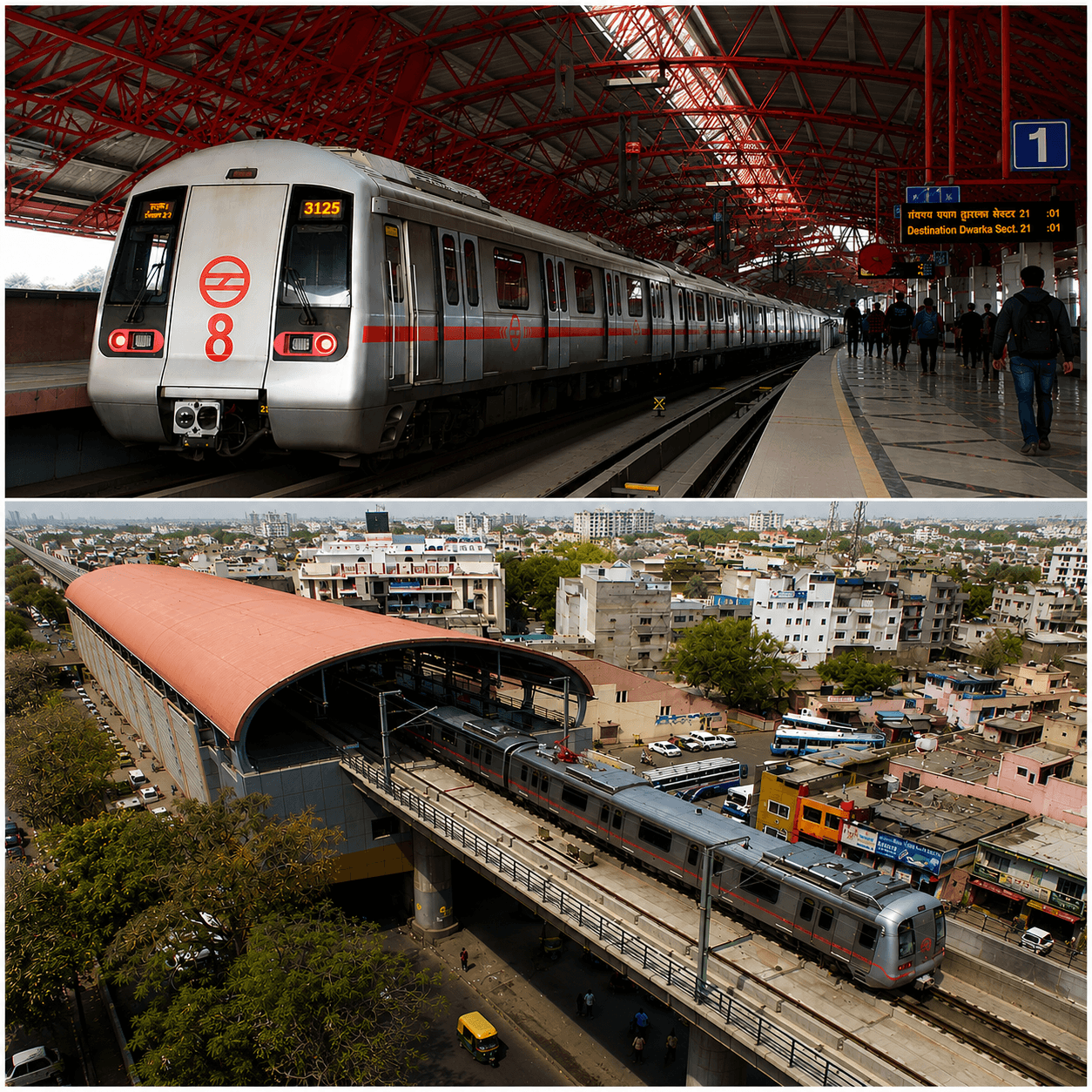
Unified spatial design: Demonstrating how explicit interchange signage and absolute color consistency from the station architecture to the continuous stripes along the entire train eliminate passenger confusion and guide the user journey effortlessly.
Image credits: Nissin, Railway News, Tripadvisor, and KMV Projects.
The Solution: Implementing Continuous Confirmation
Currently the German U Bahn network relies heavily on alphanumeric naming conventions. For local commuters who have lived in the city for years this system works because it has become Knowledge in the Head. Through years of repetition they have successfully memorized the abstract routes. If transit authorities were to completely abandon these alphanumeric names and switch entirely to a color coded system like the Delhi Metro it would severely break the established mental models of these long term users forcing them to expend extra cognitive effort to relearn the entire network. Therefore the goal is not to replace the current system but to augment it. For new users or tourists the alphanumeric codes require high cognitive effort to remember and decode.
While the U Bahn does assign specific colors to different routes these colors are not effectively utilized in the physical space. In cognitive psychology the human brain recognizes color through a mechanism called pre attentive visual processing. We process color instantly and automatically without conscious effort whereas reading text requires active mental load. To resolve this cognitive friction I propose shifting the navigation system from Knowledge in the Head to Knowledge in the World by utilizing a framework called Continuous Confirmation. By placing explicit color coded navigational cues directly into the environment we completely eliminate the need for passengers to rely on their memory or analyze dense wall maps while still preserving the alphanumeric system for the locals.
The journey begins the moment a passenger enters a major interchange hub. Borrowing the highly successful unified framework from the Delhi Metro this solution immediately maps specific rail lines to dedicated colors. On the main mezzanine multiple distinct solid floor pathways such as a prominent red path for the U2 line and a green path for the U1 line fan out in clear diverging directions. This macro level spatial mapping naturally segregates passenger traffic leading them directly toward the correct stairwell entrances and eliminating decision paralysis right at the start.
The Solution: Implementing Continuous Confirmation
Currently the German U Bahn network relies heavily on alphanumeric naming conventions. For local commuters who have lived in the city for years this system works because it has become Knowledge in the Head. Through years of repetition they have successfully memorized the abstract routes. If transit authorities were to completely abandon these alphanumeric names and switch entirely to a color coded system like the Delhi Metro it would severely break the established mental models of these long term users forcing them to expend extra cognitive effort to relearn the entire network. Therefore the goal is not to replace the current system but to augment it. For new users or tourists the alphanumeric codes require high cognitive effort to remember and decode.
While the U Bahn does assign specific colors to different routes these colors are not effectively utilized in the physical space. In cognitive psychology the human brain recognizes color through a mechanism called pre attentive visual processing. We process color instantly and automatically without conscious effort whereas reading text requires active mental load. To resolve this cognitive friction I propose shifting the navigation system from Knowledge in the Head to Knowledge in the World by utilizing a framework called Continuous Confirmation. By placing explicit color coded navigational cues directly into the environment we completely eliminate the need for passengers to rely on their memory or analyze dense wall maps while still preserving the alphanumeric system for the locals.
The journey begins the moment a passenger enters a major interchange hub. Borrowing the highly successful unified framework from the Delhi Metro this solution immediately maps specific rail lines to dedicated colors. On the main mezzanine multiple distinct solid floor pathways such as a prominent red path for the U2 line and a green path for the U1 line fan out in clear diverging directions. This macro level spatial mapping naturally segregates passenger traffic leading them directly toward the correct stairwell entrances and eliminating decision paralysis right at the start.
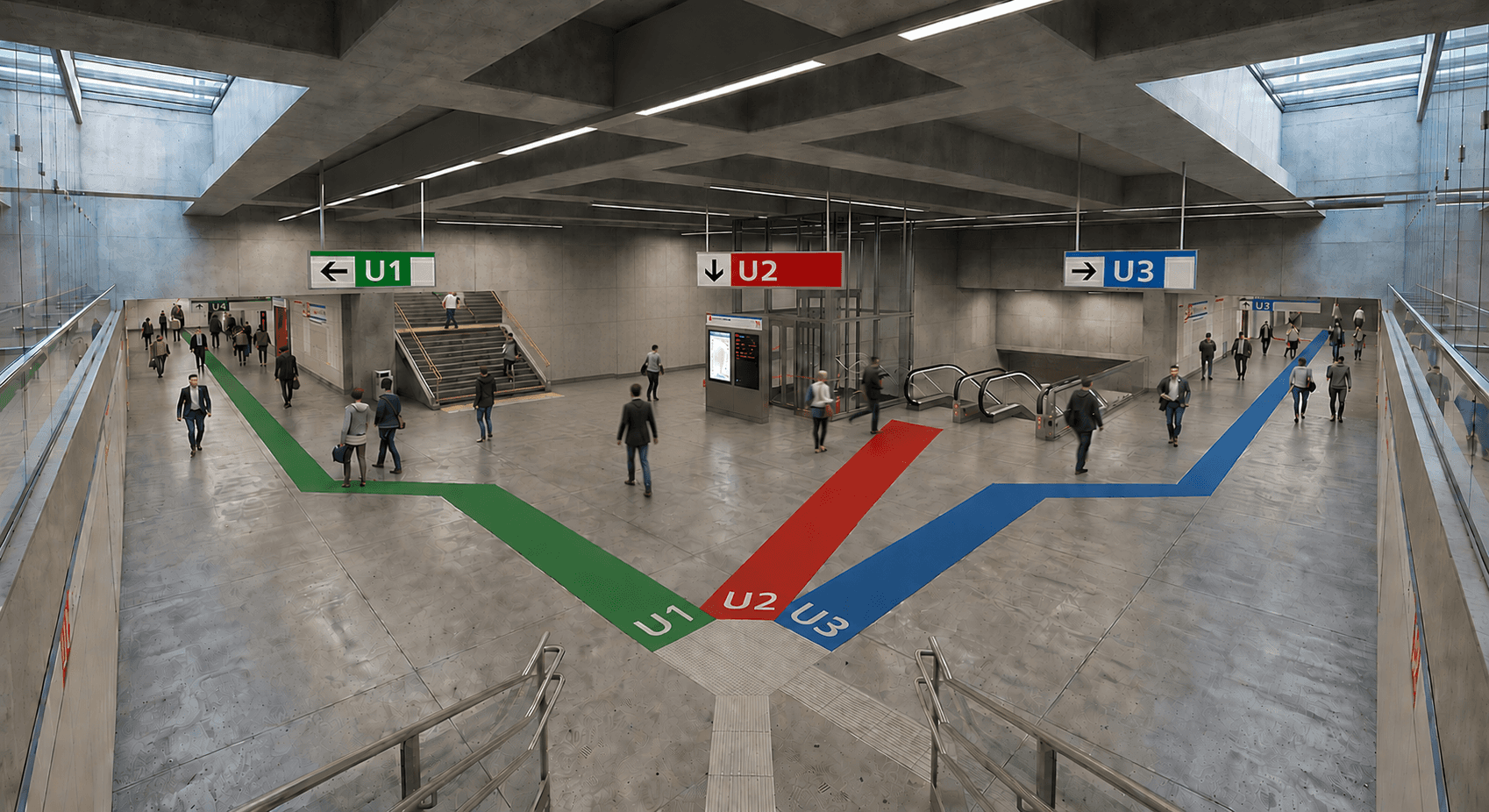
Macro level navigation: Demonstrating how distinct color coded floor paths on the main mezzanine naturally segregate passenger traffic and eliminate decision paralysis at major interchange stations.
Image credits: AI Generated Image
Once the user selects their route, this visual guidance remains unbroken across critical transition points. The designated red pathway for the U2 line is painted continuously down the center of staircase treads and seamlessly into the tiled corridors below. By keeping the path unbroken across elevation changes it acts as a constant spatial signifier preventing passengers from second guessing their route midway through the station.
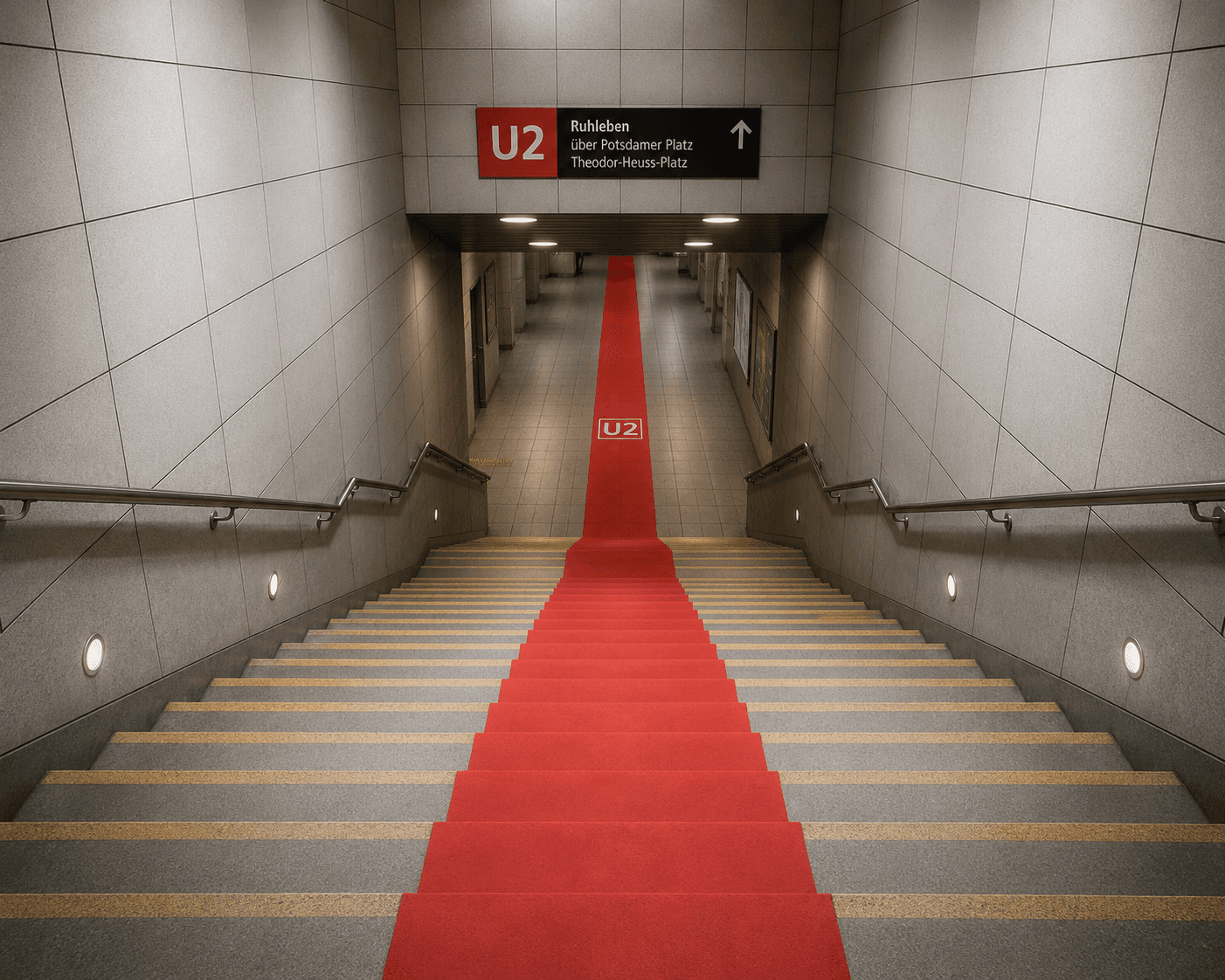
Continuous transition: Illustrating the concept of Continuous Confirmation where the color coded path remains an unbroken spatial signifier transitioning seamlessly across stairs and corridors.
Image credits: AI Generated Image
This unbroken path leads directly to the designated boarding zone on the concrete platform. When the yellow U Bahn train arrives its doors are distinctly framed with matching red accents and markers. The floor path connects perfectly with the vehicle entrance bridging the gap between the physical environment and the required user action.

Spatial mapping: Showcasing the environmental UX mockup where a persistent color coded floor pathway guides passengers directly to their matching U Bahn train door.
Image credits: AI Generated Image
Finally the system provides advanced sensory reassurance even after the user has completed the primary action. From the perspective of a passenger standing just inside the train looking out the open doorway the interior of the door frame features a prominent solid red accent panel. This directly aligns with the platform floor marking outside creating a seamless closed loop of visual feedback. This instantaneous confirmation ensures travelers know they have boarded the correct line without needing to frantically scan for small text based maps inside the carriage.

Sensory reassurance: Showcasing the completed visual feedback loop where matching colored accents on the train door and platform floor provide instantaneous confirmation that the passenger is on the correct line.
Image credits: AI Generated Image
THE Conclusion: Physical Spaces as Interfaces
To conclude this case study the core takeaway is that effective wayfinding must treat physical infrastructure exactly like a digital interface. Just as a digital product requires intuitive navigation clear signifiers and continuous feedback a physical space demands the exact same level of spatial design architecture to function successfully.
By applying rigorous UX research and spatial design principles to public transit we can fundamentally mitigate the travel anxiety that plagues complex networks like the German U Bahn. When passengers are not overwhelmed by cognitive overload and ambiguous signage they can navigate their environment with absolute confidence.
Furthermore these deliberate design interventions actively prevent structural user errors before they occur. By shifting the cognitive burden from the user to the environment through frameworks like Continuous Confirmation we create a highly accessible and intuitive system. This ensures the transit network effectively serves a beautifully diverse population regardless of their language barriers, technical literacy or prior transit experience.
THE Conclusion: Physical Spaces as Interfaces
To conclude this case study the core takeaway is that effective wayfinding must treat physical infrastructure exactly like a digital interface. Just as a digital product requires intuitive navigation clear signifiers and continuous feedback a physical space demands the exact same level of spatial design architecture to function successfully.
By applying rigorous UX research and spatial design principles to public transit we can fundamentally mitigate the travel anxiety that plagues complex networks like the German U Bahn. When passengers are not overwhelmed by cognitive overload and ambiguous signage they can navigate their environment with absolute confidence.
Furthermore these deliberate design interventions actively prevent structural user errors before they occur. By shifting the cognitive burden from the user to the environment through frameworks like Continuous Confirmation we create a highly accessible and intuitive system. This ensures the transit network effectively serves a beautifully diverse population regardless of their language barriers, technical literacy or prior transit experience.
More UX INSIGHTS

Lost in the Station: A Spatial UX Teardown of Complex Urban Transit Hubs
Lost in the Station: A Spatial UX Teardown of Complex Urban Transit Hubs
An environmental UX analysis of German transit infrastructure and the Delhi Metro demonstrating how continuous spatial signifiers optimize passenger journeys
Spatial UX
Jun 06, 2026
Breaking the Maze: Overcoming Overload in Mixed Transit Design
The physical environment is the ultimate user interface. When navigating a major transit station passengers expect a smooth and predictable journey guided by clear design. However urban transit networks often mix completely different types of travel into one single space creating massive wayfinding challenges.
During a recent trip through Hamburg Hauptbahnhof I encountered this exact structural clash. My initial goal was to catch an S Bahn. Unlike dedicated closed loop systems German S Bahn lines frequently share sprawling chaotic stations with cross country ICE and regional trains. I faced a confusing maze of overlapping platforms where local commuter transit blends right into the heavy rail network without any clear visual boundaries.
Hoping for a more streamlined experience I pivoted to the U Bahn system. Instead I encountered a completely different UX failure macro level ambiguity. The main station passages provided generic "U signs" with multiple arrows pointing in conflicting directions. Without line specific guidance from the start I was forced into a guessing game. It is incredibly frustrating to follow a generic sign down a long corridor only to discover it leads to the U3 platform when you desperately need the U2.
After failing to navigate both the S Bahn and the U Bahn due to this severe spatial ambiguity my decision fatigue peaked. I abandoned the rail network entirely and navigated my way using a local city bus.
This cascading journey failure raises a critical UX question. If dedicated metro systems can achieve seamless navigation can we apply those same principles to a chaotic mixed rail hub? By treating the physical station as an interface this Spatial analysis identifies the core design flaws in German public transport. It then proposes a continuous visual feedback solution inspired by the highly organized spatial mapping of the Delhi Metro proving that even complex networks can achieve absolute visual clarity.
Breaking the Maze: Overcoming Overload in Mixed Transit Design
The physical environment is the ultimate user interface. When navigating a major transit station passengers expect a smooth and predictable journey guided by clear design. However urban transit networks often mix completely different types of travel into one single space creating massive wayfinding challenges.
During a recent trip through Hamburg Hauptbahnhof I encountered this exact structural clash. My initial goal was to catch an S Bahn. Unlike dedicated closed loop systems German S Bahn lines frequently share sprawling chaotic stations with cross country ICE and regional trains. I faced a confusing maze of overlapping platforms where local commuter transit blends right into the heavy rail network without any clear visual boundaries.
Hoping for a more streamlined experience I pivoted to the U Bahn system. Instead I encountered a completely different UX failure macro level ambiguity. The main station passages provided generic "U signs" with multiple arrows pointing in conflicting directions. Without line specific guidance from the start I was forced into a guessing game. It is incredibly frustrating to follow a generic sign down a long corridor only to discover it leads to the U3 platform when you desperately need the U2.
After failing to navigate both the S Bahn and the U Bahn due to this severe spatial ambiguity my decision fatigue peaked. I abandoned the rail network entirely and navigated my way using a local city bus.
This cascading journey failure raises a critical UX question. If dedicated metro systems can achieve seamless navigation can we apply those same principles to a chaotic mixed rail hub? By treating the physical station as an interface this Spatial analysis identifies the core design flaws in German public transport. It then proposes a continuous visual feedback solution inspired by the highly organized spatial mapping of the Delhi Metro proving that even complex networks can achieve absolute visual clarity.
Image credit: Deutsche Bahn.
The Core Problem: Fragmented Identity in German Transit
A strong user experience relies on predictability. At first glance Germany public transit boasts a universally recognized logo system the green S for the S Bahn and the blue U for the U Bahn. This creates a false sense of national standardization.
However this consistency completely shatters the moment a passenger looks for the physical trains or platform graphics. While the logo remains constant the physical design language changes entirely from one city to another. A passenger accustomed to the bright yellow and red S Bahn trains in Berlin will find themselves searching for red and white trains in Hamburg. This visual fragmentation fractures established mental models forcing intercity travelers to completely relearn the local transit visual language with every new city they visit.
This fragmented identity extends directly into the station architecture itself creating severe macro level ambiguity. Inside a sprawling hub like Hamburg Hauptbahnhof the main navigational passages rely heavily on generic "U signs" rather than line specific guidance. Because these passages feature multiple entry and exit points new passengers are caught in a constant state of scanning looking left and right for their desired line.
For example when trying to locate the U2 line the main passage simply provides generic "U logos" paired with multiple arrows pointing left, right or sometimes in both directions simultaneously. A passenger might follow an arrow to the left only to discover at the very end of the corridor that the path leads exclusively to the U3.
Even upon miraculously reaching the correct platform this structural ambiguity persists. Overhead signboards frequently display conflicting visual information. A single sign might feature two arrows pointing left and right to indicate boarding directions while a third isolated arrow simply points to a train number without clear context.
By failing to maintain cross platform design consistency the system transforms a basic commute into a high cognitive load puzzle. When users cannot rely on their cognitive maps or intuitive visual signifiers the spatial UX completely breaks down.
The Core Problem: Fragmented Identity in German Transit
A strong user experience relies on predictability. At first glance Germany public transit boasts a universally recognized logo system the green S for the S Bahn and the blue U for the U Bahn. This creates a false sense of national standardization.
However this consistency completely shatters the moment a passenger looks for the physical trains or platform graphics. While the logo remains constant the physical design language changes entirely from one city to another. A passenger accustomed to the bright yellow and red S Bahn trains in Berlin will find themselves searching for red and white trains in Hamburg. This visual fragmentation fractures established mental models forcing intercity travelers to completely relearn the local transit visual language with every new city they visit.
This fragmented identity extends directly into the station architecture itself creating severe macro level ambiguity. Inside a sprawling hub like Hamburg Hauptbahnhof the main navigational passages rely heavily on generic "U signs" rather than line specific guidance. Because these passages feature multiple entry and exit points new passengers are caught in a constant state of scanning looking left and right for their desired line.
For example when trying to locate the U2 line the main passage simply provides generic "U logos" paired with multiple arrows pointing left, right or sometimes in both directions simultaneously. A passenger might follow an arrow to the left only to discover at the very end of the corridor that the path leads exclusively to the U3.
Even upon miraculously reaching the correct platform this structural ambiguity persists. Overhead signboards frequently display conflicting visual information. A single sign might feature two arrows pointing left and right to indicate boarding directions while a third isolated arrow simply points to a train number without clear context.
By failing to maintain cross platform design consistency the system transforms a basic commute into a high cognitive load puzzle. When users cannot rely on their cognitive maps or intuitive visual signifiers the spatial UX completely breaks down.
Design inconsistency: Comparing the different train colors across cities to show how changing physical designs force travelers to relearn the system every time they travel.
Image credits: Berlin Wanderlust, i2030, Facebook HVV Page, and Hochbahn.
The UX Breakdown: Why the Current System Fails
To understand why this transit architecture fails we must evaluate it using established UX methodologies. The German mixed rail system frequently violates fundamental usability heuristics turning simple navigation into a high cognitive load puzzle.
First the system severely violates Nielsen's Heuristic 4: Consistency and Standards. While the green S and blue U logos establish a visual standard at the station entrance this promise is abandoned on the physical platforms and trains. When users cannot rely on consistent color mapping their established mental models break down.
Second the station architecture violates Nielsen's Heuristic 6: Recognition rather than Recall. Instead of recognizing a clear colored path passengers must actively memorize complex platform rules and navigate through generic corridors. Relying on the ambiguous generic "U signs" as mentioned earlier rather than signs that clearly point to specific train routes it places an entirely unfair cognitive burden on the passenger.
This structural ambiguity peaks at the platform level perfectly illustrating Hick Law. When users are presented with too many complex choices decision making paralyzes. Overhead signboards frequently display conflicting visual information. A single sign might feature two arrows pointing left and right to indicate boarding directions while a third isolated arrow simply points to a train number without clear context. This overwhelming text signage paralyzes passenger flow and guarantees wayfinding errors.
The UX Breakdown: Why the Current System Fails
To understand why this transit architecture fails we must evaluate it using established UX methodologies. The German mixed rail system frequently violates fundamental usability heuristics turning simple navigation into a high cognitive load puzzle.
First the system severely violates Nielsen's Heuristic 4: Consistency and Standards. While the green S and blue U logos establish a visual standard at the station entrance this promise is abandoned on the physical platforms and trains. When users cannot rely on consistent color mapping their established mental models break down.
Second the station architecture violates Nielsen's Heuristic 6: Recognition rather than Recall. Instead of recognizing a clear colored path passengers must actively memorize complex platform rules and navigate through generic corridors. Relying on the ambiguous generic "U signs" as mentioned earlier rather than signs that clearly point to specific train routes it places an entirely unfair cognitive burden on the passenger.
This structural ambiguity peaks at the platform level perfectly illustrating Hick Law. When users are presented with too many complex choices decision making paralyzes. Overhead signboards frequently display conflicting visual information. A single sign might feature two arrows pointing left and right to indicate boarding directions while a third isolated arrow simply points to a train number without clear context. This overwhelming text signage paralyzes passenger flow and guarantees wayfinding errors.
Spatial ambiguity: Demonstrating how conflicting directional arrows without clear context force travelers into a stressful guessing game right at the platform.
Image credits: Show Me The Journey, Berliner Zeitung, and Alamy.
The Global Benchmark: Deconstructing the Delhi Metro
While the German S Bahn shares chaotic platforms with heavy regional rail the U Bahn operates as a dedicated closed loop system. In theory this structure should make navigation effortless. However as demonstrated by the confusing corridors and conflicting arrows found in major German transit hubs even a closed loop network fails when it relies on generic signage and fragmented visual cues. To see how these macro and micro level ambiguities can be completely eliminated we can look to the Delhi Metro. It is a network operating on the exact same closed loop logic as the U Bahn but it stands as a global masterclass in unified service design.
The Delhi Metro prevents spatial ambiguity through absolute color consistency especially during complex line transfers. At major interchange hubs like Rajiv Chowk massive overhead signboards do not simply point arrows they explicitly map user behavior. The signs clearly instruct passengers to follow specific colored train symbols and matching colored footprints on the floor such as a blue footprint for the Blue Line or a yellow footprint for the Yellow Line. This brilliant UX intervention seamlessly connects the overhead information directly to the physical ground ensuring passengers never have to guess their path.
Taking this color consistency further every single user touchpoint is unified by its specific line color. The navigational footprints painted on the floor match the train exterior which bears a prominent colored stripe. This unified standard extends to the architectural level across modern Indian metro rail transit networks including the Jaipur Metro where the station roof itself is painted entirely in pink to match the transit line. Instead of wandering down long passages hoping to find the correct platform, passengers simply follow an unbroken visual path from the station interchange directly to their train.
Beyond basic wayfinding the system provides advanced sensory reassurance to manage high density crowds. Inside the trains dynamic digital and audio visual indicators signal exactly which side the doors will open next removing last minute passenger panic and directional guessing.
At the platform level the Delhi Metro utilizes clear exiting passenger flow indicators. Bright directional floor markings and chevrons clearly designate exactly where passengers exiting the train will step out. This creates dedicated waiting zones that naturally separate incoming and outgoing passenger flows preventing bottlenecks and eliminating the platform level confusion seen under the overcrowded German overhead signs. By prioritizing recognition over recall the system entirely eliminates cognitive friction.
The Global Benchmark: Deconstructing the Delhi Metro
While the German S Bahn shares chaotic platforms with heavy regional rail the U Bahn operates as a dedicated closed loop system. In theory this structure should make navigation effortless. However as demonstrated by the confusing corridors and conflicting arrows found in major German transit hubs even a closed loop network fails when it relies on generic signage and fragmented visual cues. To see how these macro and micro level ambiguities can be completely eliminated we can look to the Delhi Metro. It is a network operating on the exact same closed loop logic as the U Bahn but it stands as a global masterclass in unified service design.
The Delhi Metro prevents spatial ambiguity through absolute color consistency especially during complex line transfers. At major interchange hubs like Rajiv Chowk massive overhead signboards do not simply point arrows they explicitly map user behavior. The signs clearly instruct passengers to follow specific colored train symbols and matching colored footprints on the floor such as a blue footprint for the Blue Line or a yellow footprint for the Yellow Line. This brilliant UX intervention seamlessly connects the overhead information directly to the physical ground ensuring passengers never have to guess their path.
Taking this color consistency further every single user touchpoint is unified by its specific line color. The navigational footprints painted on the floor match the train exterior which bears a prominent colored stripe. This unified standard extends to the architectural level across modern Indian metro rail transit networks including the Jaipur Metro where the station roof itself is painted entirely in pink to match the transit line. Instead of wandering down long passages hoping to find the correct platform, passengers simply follow an unbroken visual path from the station interchange directly to their train.
Beyond basic wayfinding the system provides advanced sensory reassurance to manage high density crowds. Inside the trains dynamic digital and audio visual indicators signal exactly which side the doors will open next removing last minute passenger panic and directional guessing.
At the platform level the Delhi Metro utilizes clear exiting passenger flow indicators. Bright directional floor markings and chevrons clearly designate exactly where passengers exiting the train will step out. This creates dedicated waiting zones that naturally separate incoming and outgoing passenger flows preventing bottlenecks and eliminating the platform level confusion seen under the overcrowded German overhead signs. By prioritizing recognition over recall the system entirely eliminates cognitive friction.
Unified spatial design: Demonstrating how explicit interchange signage and absolute color consistency from the station architecture to the continuous stripes along the entire train eliminate passenger confusion and guide the user journey effortlessly.
Image credits: Nissin, Railway News, Tripadvisor, and KMV Projects.
The Solution: Implementing Continuous Confirmation
Currently the German U Bahn network relies heavily on alphanumeric naming conventions. For local commuters who have lived in the city for years this system works because it has become Knowledge in the Head. Through years of repetition they have successfully memorized the abstract routes. If transit authorities were to completely abandon these alphanumeric names and switch entirely to a color coded system like the Delhi Metro it would severely break the established mental models of these long term users forcing them to expend extra cognitive effort to relearn the entire network. Therefore the goal is not to replace the current system but to augment it. For new users or tourists the alphanumeric codes require high cognitive effort to remember and decode.
While the U Bahn does assign specific colors to different routes these colors are not effectively utilized in the physical space. In cognitive psychology the human brain recognizes color through a mechanism called pre attentive visual processing. We process color instantly and automatically without conscious effort whereas reading text requires active mental load. To resolve this cognitive friction I propose shifting the navigation system from Knowledge in the Head to Knowledge in the World by utilizing a framework called Continuous Confirmation. By placing explicit color coded navigational cues directly into the environment we completely eliminate the need for passengers to rely on their memory or analyze dense wall maps while still preserving the alphanumeric system for the locals.
The journey begins the moment a passenger enters a major interchange hub. Borrowing the highly successful unified framework from the Delhi Metro this solution immediately maps specific rail lines to dedicated colors. On the main mezzanine multiple distinct solid floor pathways such as a prominent red path for the U2 line and a green path for the U1 line fan out in clear diverging directions. This macro level spatial mapping naturally segregates passenger traffic leading them directly toward the correct stairwell entrances and eliminating decision paralysis right at the start.
The Solution: Implementing Continuous Confirmation
Currently the German U Bahn network relies heavily on alphanumeric naming conventions. For local commuters who have lived in the city for years this system works because it has become Knowledge in the Head. Through years of repetition they have successfully memorized the abstract routes. If transit authorities were to completely abandon these alphanumeric names and switch entirely to a color coded system like the Delhi Metro it would severely break the established mental models of these long term users forcing them to expend extra cognitive effort to relearn the entire network. Therefore the goal is not to replace the current system but to augment it. For new users or tourists the alphanumeric codes require high cognitive effort to remember and decode.
While the U Bahn does assign specific colors to different routes these colors are not effectively utilized in the physical space. In cognitive psychology the human brain recognizes color through a mechanism called pre attentive visual processing. We process color instantly and automatically without conscious effort whereas reading text requires active mental load. To resolve this cognitive friction I propose shifting the navigation system from Knowledge in the Head to Knowledge in the World by utilizing a framework called Continuous Confirmation. By placing explicit color coded navigational cues directly into the environment we completely eliminate the need for passengers to rely on their memory or analyze dense wall maps while still preserving the alphanumeric system for the locals.
The journey begins the moment a passenger enters a major interchange hub. Borrowing the highly successful unified framework from the Delhi Metro this solution immediately maps specific rail lines to dedicated colors. On the main mezzanine multiple distinct solid floor pathways such as a prominent red path for the U2 line and a green path for the U1 line fan out in clear diverging directions. This macro level spatial mapping naturally segregates passenger traffic leading them directly toward the correct stairwell entrances and eliminating decision paralysis right at the start.
Macro level navigation: Demonstrating how distinct color coded floor paths on the main mezzanine naturally segregate passenger traffic and eliminate decision paralysis at major interchange stations.
Image credits: AI Generated Image
Once the user selects their route, this visual guidance remains unbroken across critical transition points. The designated red pathway for the U2 line is painted continuously down the center of staircase treads and seamlessly into the tiled corridors below. By keeping the path unbroken across elevation changes it acts as a constant spatial signifier preventing passengers from second guessing their route midway through the station.
Continuous transition: Illustrating the concept of Continuous Confirmation where the color coded path remains an unbroken spatial signifier transitioning seamlessly across stairs and corridors.
Image credits: AI Generated Image
This unbroken path leads directly to the designated boarding zone on the concrete platform. When the yellow U Bahn train arrives its doors are distinctly framed with matching red accents and markers. The floor path connects perfectly with the vehicle entrance bridging the gap between the physical environment and the required user action.
Spatial mapping: Showcasing the environmental UX mockup where a persistent color coded floor pathway guides passengers directly to their matching U Bahn train door.
Image credits: AI Generated Image
Finally the system provides advanced sensory reassurance even after the user has completed the primary action. From the perspective of a passenger standing just inside the train looking out the open doorway the interior of the door frame features a prominent solid red accent panel. This directly aligns with the platform floor marking outside creating a seamless closed loop of visual feedback. This instantaneous confirmation ensures travelers know they have boarded the correct line without needing to frantically scan for small text based maps inside the carriage.
Sensory reassurance: Showcasing the completed visual feedback loop where matching colored accents on the train door and platform floor provide instantaneous confirmation that the passenger is on the correct line.
Image credits: AI Generated Image
THE Conclusion: Physical Spaces as Interfaces
To conclude this case study the core takeaway is that effective wayfinding must treat physical infrastructure exactly like a digital interface. Just as a digital product requires intuitive navigation clear signifiers and continuous feedback a physical space demands the exact same level of spatial design architecture to function successfully.
By applying rigorous UX research and spatial design principles to public transit we can fundamentally mitigate the travel anxiety that plagues complex networks like the German U Bahn. When passengers are not overwhelmed by cognitive overload and ambiguous signage they can navigate their environment with absolute confidence.
Furthermore these deliberate design interventions actively prevent structural user errors before they occur. By shifting the cognitive burden from the user to the environment through frameworks like Continuous Confirmation we create a highly accessible and intuitive system. This ensures the transit network effectively serves a beautifully diverse population regardless of their language barriers, technical literacy or prior transit experience.
THE Conclusion: Physical Spaces as Interfaces
To conclude this case study the core takeaway is that effective wayfinding must treat physical infrastructure exactly like a digital interface. Just as a digital product requires intuitive navigation clear signifiers and continuous feedback a physical space demands the exact same level of spatial design architecture to function successfully.
By applying rigorous UX research and spatial design principles to public transit we can fundamentally mitigate the travel anxiety that plagues complex networks like the German U Bahn. When passengers are not overwhelmed by cognitive overload and ambiguous signage they can navigate their environment with absolute confidence.
Furthermore these deliberate design interventions actively prevent structural user errors before they occur. By shifting the cognitive burden from the user to the environment through frameworks like Continuous Confirmation we create a highly accessible and intuitive system. This ensures the transit network effectively serves a beautifully diverse population regardless of their language barriers, technical literacy or prior transit experience.
More UX INSIGHTS
Lost in the Station: A Spatial UX Teardown of Complex Urban Transit Hubs
Lost in the Station: A Spatial UX Teardown of Complex Urban Transit Hubs
An environmental UX analysis of German transit infrastructure and the Delhi Metro demonstrating how continuous spatial signifiers optimize passenger journeys
Spatial UX
Jun 06, 2026
Breaking the Maze: Overcoming Overload in Mixed Transit Design
The physical environment is the ultimate user interface. When navigating a major transit station passengers expect a smooth and predictable journey guided by clear design. However urban transit networks often mix completely different types of travel into one single space creating massive wayfinding challenges.
During a recent trip through Hamburg Hauptbahnhof I encountered this exact structural clash. My initial goal was to catch an S Bahn. Unlike dedicated closed loop systems German S Bahn lines frequently share sprawling chaotic stations with cross country ICE and regional trains. I faced a confusing maze of overlapping platforms where local commuter transit blends right into the heavy rail network without any clear visual boundaries.
Hoping for a more streamlined experience I pivoted to the U Bahn system. Instead I encountered a completely different UX failure macro level ambiguity. The main station passages provided generic "U signs" with multiple arrows pointing in conflicting directions. Without line specific guidance from the start I was forced into a guessing game. It is incredibly frustrating to follow a generic sign down a long corridor only to discover it leads to the U3 platform when you desperately need the U2.
After failing to navigate both the S Bahn and the U Bahn due to this severe spatial ambiguity my decision fatigue peaked. I abandoned the rail network entirely and navigated my way using a local city bus.
This cascading journey failure raises a critical UX question. If dedicated metro systems can achieve seamless navigation can we apply those same principles to a chaotic mixed rail hub? By treating the physical station as an interface this Spatial analysis identifies the core design flaws in German public transport. It then proposes a continuous visual feedback solution inspired by the highly organized spatial mapping of the Delhi Metro proving that even complex networks can achieve absolute visual clarity.
Breaking the Maze: Overcoming Overload in Mixed Transit Design
The physical environment is the ultimate user interface. When navigating a major transit station passengers expect a smooth and predictable journey guided by clear design. However urban transit networks often mix completely different types of travel into one single space creating massive wayfinding challenges.
During a recent trip through Hamburg Hauptbahnhof I encountered this exact structural clash. My initial goal was to catch an S Bahn. Unlike dedicated closed loop systems German S Bahn lines frequently share sprawling chaotic stations with cross country ICE and regional trains. I faced a confusing maze of overlapping platforms where local commuter transit blends right into the heavy rail network without any clear visual boundaries.
Hoping for a more streamlined experience I pivoted to the U Bahn system. Instead I encountered a completely different UX failure macro level ambiguity. The main station passages provided generic "U signs" with multiple arrows pointing in conflicting directions. Without line specific guidance from the start I was forced into a guessing game. It is incredibly frustrating to follow a generic sign down a long corridor only to discover it leads to the U3 platform when you desperately need the U2.
After failing to navigate both the S Bahn and the U Bahn due to this severe spatial ambiguity my decision fatigue peaked. I abandoned the rail network entirely and navigated my way using a local city bus.
This cascading journey failure raises a critical UX question. If dedicated metro systems can achieve seamless navigation can we apply those same principles to a chaotic mixed rail hub? By treating the physical station as an interface this Spatial analysis identifies the core design flaws in German public transport. It then proposes a continuous visual feedback solution inspired by the highly organized spatial mapping of the Delhi Metro proving that even complex networks can achieve absolute visual clarity.
Image credit: Deutsche Bahn.
The Core Problem: Fragmented Identity in German Transit
A strong user experience relies on predictability. At first glance Germany public transit boasts a universally recognized logo system the green S for the S Bahn and the blue U for the U Bahn. This creates a false sense of national standardization.
However this consistency completely shatters the moment a passenger looks for the physical trains or platform graphics. While the logo remains constant the physical design language changes entirely from one city to another. A passenger accustomed to the bright yellow and red S Bahn trains in Berlin will find themselves searching for red and white trains in Hamburg. This visual fragmentation fractures established mental models forcing intercity travelers to completely relearn the local transit visual language with every new city they visit.
This fragmented identity extends directly into the station architecture itself creating severe macro level ambiguity. Inside a sprawling hub like Hamburg Hauptbahnhof the main navigational passages rely heavily on generic "U signs" rather than line specific guidance. Because these passages feature multiple entry and exit points new passengers are caught in a constant state of scanning looking left and right for their desired line.
For example when trying to locate the U2 line the main passage simply provides generic "U logos" paired with multiple arrows pointing left, right or sometimes in both directions simultaneously. A passenger might follow an arrow to the left only to discover at the very end of the corridor that the path leads exclusively to the U3.
Even upon miraculously reaching the correct platform this structural ambiguity persists. Overhead signboards frequently display conflicting visual information. A single sign might feature two arrows pointing left and right to indicate boarding directions while a third isolated arrow simply points to a train number without clear context.
By failing to maintain cross platform design consistency the system transforms a basic commute into a high cognitive load puzzle. When users cannot rely on their cognitive maps or intuitive visual signifiers the spatial UX completely breaks down.
The Core Problem: Fragmented Identity in German Transit
A strong user experience relies on predictability. At first glance Germany public transit boasts a universally recognized logo system the green S for the S Bahn and the blue U for the U Bahn. This creates a false sense of national standardization.
However this consistency completely shatters the moment a passenger looks for the physical trains or platform graphics. While the logo remains constant the physical design language changes entirely from one city to another. A passenger accustomed to the bright yellow and red S Bahn trains in Berlin will find themselves searching for red and white trains in Hamburg. This visual fragmentation fractures established mental models forcing intercity travelers to completely relearn the local transit visual language with every new city they visit.
This fragmented identity extends directly into the station architecture itself creating severe macro level ambiguity. Inside a sprawling hub like Hamburg Hauptbahnhof the main navigational passages rely heavily on generic "U signs" rather than line specific guidance. Because these passages feature multiple entry and exit points new passengers are caught in a constant state of scanning looking left and right for their desired line.
For example when trying to locate the U2 line the main passage simply provides generic "U logos" paired with multiple arrows pointing left, right or sometimes in both directions simultaneously. A passenger might follow an arrow to the left only to discover at the very end of the corridor that the path leads exclusively to the U3.
Even upon miraculously reaching the correct platform this structural ambiguity persists. Overhead signboards frequently display conflicting visual information. A single sign might feature two arrows pointing left and right to indicate boarding directions while a third isolated arrow simply points to a train number without clear context.
By failing to maintain cross platform design consistency the system transforms a basic commute into a high cognitive load puzzle. When users cannot rely on their cognitive maps or intuitive visual signifiers the spatial UX completely breaks down.
Design inconsistency: Comparing the different train colors across cities to show how changing physical designs force travelers to relearn the system every time they travel.
Image credits: Berlin Wanderlust, i2030, Facebook HVV Page, and Hochbahn.
The UX Breakdown: Why the Current System Fails
To understand why this transit architecture fails we must evaluate it using established UX methodologies. The German mixed rail system frequently violates fundamental usability heuristics turning simple navigation into a high cognitive load puzzle.
First the system severely violates Nielsen's Heuristic 4: Consistency and Standards. While the green S and blue U logos establish a visual standard at the station entrance this promise is abandoned on the physical platforms and trains. When users cannot rely on consistent color mapping their established mental models break down.
Second the station architecture violates Nielsen's Heuristic 6: Recognition rather than Recall. Instead of recognizing a clear colored path passengers must actively memorize complex platform rules and navigate through generic corridors. Relying on the ambiguous generic "U signs" as mentioned earlier rather than signs that clearly point to specific train routes it places an entirely unfair cognitive burden on the passenger.
This structural ambiguity peaks at the platform level perfectly illustrating Hick Law. When users are presented with too many complex choices decision making paralyzes. Overhead signboards frequently display conflicting visual information. A single sign might feature two arrows pointing left and right to indicate boarding directions while a third isolated arrow simply points to a train number without clear context. This overwhelming text signage paralyzes passenger flow and guarantees wayfinding errors.
The UX Breakdown: Why the Current System Fails
To understand why this transit architecture fails we must evaluate it using established UX methodologies. The German mixed rail system frequently violates fundamental usability heuristics turning simple navigation into a high cognitive load puzzle.
First the system severely violates Nielsen's Heuristic 4: Consistency and Standards. While the green S and blue U logos establish a visual standard at the station entrance this promise is abandoned on the physical platforms and trains. When users cannot rely on consistent color mapping their established mental models break down.
Second the station architecture violates Nielsen's Heuristic 6: Recognition rather than Recall. Instead of recognizing a clear colored path passengers must actively memorize complex platform rules and navigate through generic corridors. Relying on the ambiguous generic "U signs" as mentioned earlier rather than signs that clearly point to specific train routes it places an entirely unfair cognitive burden on the passenger.
This structural ambiguity peaks at the platform level perfectly illustrating Hick Law. When users are presented with too many complex choices decision making paralyzes. Overhead signboards frequently display conflicting visual information. A single sign might feature two arrows pointing left and right to indicate boarding directions while a third isolated arrow simply points to a train number without clear context. This overwhelming text signage paralyzes passenger flow and guarantees wayfinding errors.
Spatial ambiguity: Demonstrating how conflicting directional arrows without clear context force travelers into a stressful guessing game right at the platform.
Image credits: Show Me The Journey, Berliner Zeitung, and Alamy.
The Global Benchmark: Deconstructing the Delhi Metro
While the German S Bahn shares chaotic platforms with heavy regional rail the U Bahn operates as a dedicated closed loop system. In theory this structure should make navigation effortless. However as demonstrated by the confusing corridors and conflicting arrows found in major German transit hubs even a closed loop network fails when it relies on generic signage and fragmented visual cues. To see how these macro and micro level ambiguities can be completely eliminated we can look to the Delhi Metro. It is a network operating on the exact same closed loop logic as the U Bahn but it stands as a global masterclass in unified service design.
The Delhi Metro prevents spatial ambiguity through absolute color consistency especially during complex line transfers. At major interchange hubs like Rajiv Chowk massive overhead signboards do not simply point arrows they explicitly map user behavior. The signs clearly instruct passengers to follow specific colored train symbols and matching colored footprints on the floor such as a blue footprint for the Blue Line or a yellow footprint for the Yellow Line. This brilliant UX intervention seamlessly connects the overhead information directly to the physical ground ensuring passengers never have to guess their path.
Taking this color consistency further every single user touchpoint is unified by its specific line color. The navigational footprints painted on the floor match the train exterior which bears a prominent colored stripe. This unified standard extends to the architectural level across modern Indian metro rail transit networks including the Jaipur Metro where the station roof itself is painted entirely in pink to match the transit line. Instead of wandering down long passages hoping to find the correct platform, passengers simply follow an unbroken visual path from the station interchange directly to their train.
Beyond basic wayfinding the system provides advanced sensory reassurance to manage high density crowds. Inside the trains dynamic digital and audio visual indicators signal exactly which side the doors will open next removing last minute passenger panic and directional guessing.
At the platform level the Delhi Metro utilizes clear exiting passenger flow indicators. Bright directional floor markings and chevrons clearly designate exactly where passengers exiting the train will step out. This creates dedicated waiting zones that naturally separate incoming and outgoing passenger flows preventing bottlenecks and eliminating the platform level confusion seen under the overcrowded German overhead signs. By prioritizing recognition over recall the system entirely eliminates cognitive friction.
The Global Benchmark: Deconstructing the Delhi Metro
While the German S Bahn shares chaotic platforms with heavy regional rail the U Bahn operates as a dedicated closed loop system. In theory this structure should make navigation effortless. However as demonstrated by the confusing corridors and conflicting arrows found in major German transit hubs even a closed loop network fails when it relies on generic signage and fragmented visual cues. To see how these macro and micro level ambiguities can be completely eliminated we can look to the Delhi Metro. It is a network operating on the exact same closed loop logic as the U Bahn but it stands as a global masterclass in unified service design.
The Delhi Metro prevents spatial ambiguity through absolute color consistency especially during complex line transfers. At major interchange hubs like Rajiv Chowk massive overhead signboards do not simply point arrows they explicitly map user behavior. The signs clearly instruct passengers to follow specific colored train symbols and matching colored footprints on the floor such as a blue footprint for the Blue Line or a yellow footprint for the Yellow Line. This brilliant UX intervention seamlessly connects the overhead information directly to the physical ground ensuring passengers never have to guess their path.
Taking this color consistency further every single user touchpoint is unified by its specific line color. The navigational footprints painted on the floor match the train exterior which bears a prominent colored stripe. This unified standard extends to the architectural level across modern Indian metro rail transit networks including the Jaipur Metro where the station roof itself is painted entirely in pink to match the transit line. Instead of wandering down long passages hoping to find the correct platform, passengers simply follow an unbroken visual path from the station interchange directly to their train.
Beyond basic wayfinding the system provides advanced sensory reassurance to manage high density crowds. Inside the trains dynamic digital and audio visual indicators signal exactly which side the doors will open next removing last minute passenger panic and directional guessing.
At the platform level the Delhi Metro utilizes clear exiting passenger flow indicators. Bright directional floor markings and chevrons clearly designate exactly where passengers exiting the train will step out. This creates dedicated waiting zones that naturally separate incoming and outgoing passenger flows preventing bottlenecks and eliminating the platform level confusion seen under the overcrowded German overhead signs. By prioritizing recognition over recall the system entirely eliminates cognitive friction.
Unified spatial design: Demonstrating how explicit interchange signage and absolute color consistency from the station architecture to the continuous stripes along the entire train eliminate passenger confusion and guide the user journey effortlessly.
Image credits: Nissin, Railway News, Tripadvisor, and KMV Projects.
The Solution: Implementing Continuous Confirmation
Currently the German U Bahn network relies heavily on alphanumeric naming conventions. For local commuters who have lived in the city for years this system works because it has become Knowledge in the Head. Through years of repetition they have successfully memorized the abstract routes. If transit authorities were to completely abandon these alphanumeric names and switch entirely to a color coded system like the Delhi Metro it would severely break the established mental models of these long term users forcing them to expend extra cognitive effort to relearn the entire network. Therefore the goal is not to replace the current system but to augment it. For new users or tourists the alphanumeric codes require high cognitive effort to remember and decode.
While the U Bahn does assign specific colors to different routes these colors are not effectively utilized in the physical space. In cognitive psychology the human brain recognizes color through a mechanism called pre attentive visual processing. We process color instantly and automatically without conscious effort whereas reading text requires active mental load. To resolve this cognitive friction I propose shifting the navigation system from Knowledge in the Head to Knowledge in the World by utilizing a framework called Continuous Confirmation. By placing explicit color coded navigational cues directly into the environment we completely eliminate the need for passengers to rely on their memory or analyze dense wall maps while still preserving the alphanumeric system for the locals.
The journey begins the moment a passenger enters a major interchange hub. Borrowing the highly successful unified framework from the Delhi Metro this solution immediately maps specific rail lines to dedicated colors. On the main mezzanine multiple distinct solid floor pathways such as a prominent red path for the U2 line and a green path for the U1 line fan out in clear diverging directions. This macro level spatial mapping naturally segregates passenger traffic leading them directly toward the correct stairwell entrances and eliminating decision paralysis right at the start.
The Solution: Implementing Continuous Confirmation
Currently the German U Bahn network relies heavily on alphanumeric naming conventions. For local commuters who have lived in the city for years this system works because it has become Knowledge in the Head. Through years of repetition they have successfully memorized the abstract routes. If transit authorities were to completely abandon these alphanumeric names and switch entirely to a color coded system like the Delhi Metro it would severely break the established mental models of these long term users forcing them to expend extra cognitive effort to relearn the entire network. Therefore the goal is not to replace the current system but to augment it. For new users or tourists the alphanumeric codes require high cognitive effort to remember and decode.
While the U Bahn does assign specific colors to different routes these colors are not effectively utilized in the physical space. In cognitive psychology the human brain recognizes color through a mechanism called pre attentive visual processing. We process color instantly and automatically without conscious effort whereas reading text requires active mental load. To resolve this cognitive friction I propose shifting the navigation system from Knowledge in the Head to Knowledge in the World by utilizing a framework called Continuous Confirmation. By placing explicit color coded navigational cues directly into the environment we completely eliminate the need for passengers to rely on their memory or analyze dense wall maps while still preserving the alphanumeric system for the locals.
The journey begins the moment a passenger enters a major interchange hub. Borrowing the highly successful unified framework from the Delhi Metro this solution immediately maps specific rail lines to dedicated colors. On the main mezzanine multiple distinct solid floor pathways such as a prominent red path for the U2 line and a green path for the U1 line fan out in clear diverging directions. This macro level spatial mapping naturally segregates passenger traffic leading them directly toward the correct stairwell entrances and eliminating decision paralysis right at the start.
Macro level navigation: Demonstrating how distinct color coded floor paths on the main mezzanine naturally segregate passenger traffic and eliminate decision paralysis at major interchange stations.
Image credits: AI Generated Image
Once the user selects their route, this visual guidance remains unbroken across critical transition points. The designated red pathway for the U2 line is painted continuously down the center of staircase treads and seamlessly into the tiled corridors below. By keeping the path unbroken across elevation changes it acts as a constant spatial signifier preventing passengers from second guessing their route midway through the station.
Continuous transition: Illustrating the concept of Continuous Confirmation where the color coded path remains an unbroken spatial signifier transitioning seamlessly across stairs and corridors.
Image credits: AI Generated Image
This unbroken path leads directly to the designated boarding zone on the concrete platform. When the yellow U Bahn train arrives its doors are distinctly framed with matching red accents and markers. The floor path connects perfectly with the vehicle entrance bridging the gap between the physical environment and the required user action.
Spatial mapping: Showcasing the environmental UX mockup where a persistent color coded floor pathway guides passengers directly to their matching U Bahn train door.
Image credits: AI Generated Image
Finally the system provides advanced sensory reassurance even after the user has completed the primary action. From the perspective of a passenger standing just inside the train looking out the open doorway the interior of the door frame features a prominent solid red accent panel. This directly aligns with the platform floor marking outside creating a seamless closed loop of visual feedback. This instantaneous confirmation ensures travelers know they have boarded the correct line without needing to frantically scan for small text based maps inside the carriage.
Sensory reassurance: Showcasing the completed visual feedback loop where matching colored accents on the train door and platform floor provide instantaneous confirmation that the passenger is on the correct line.
Image credits: AI Generated Image
THE Conclusion: Physical Spaces as Interfaces
To conclude this case study the core takeaway is that effective wayfinding must treat physical infrastructure exactly like a digital interface. Just as a digital product requires intuitive navigation clear signifiers and continuous feedback a physical space demands the exact same level of spatial design architecture to function successfully.
By applying rigorous UX research and spatial design principles to public transit we can fundamentally mitigate the travel anxiety that plagues complex networks like the German U Bahn. When passengers are not overwhelmed by cognitive overload and ambiguous signage they can navigate their environment with absolute confidence.
Furthermore these deliberate design interventions actively prevent structural user errors before they occur. By shifting the cognitive burden from the user to the environment through frameworks like Continuous Confirmation we create a highly accessible and intuitive system. This ensures the transit network effectively serves a beautifully diverse population regardless of their language barriers, technical literacy or prior transit experience.
THE Conclusion: Physical Spaces as Interfaces
To conclude this case study the core takeaway is that effective wayfinding must treat physical infrastructure exactly like a digital interface. Just as a digital product requires intuitive navigation clear signifiers and continuous feedback a physical space demands the exact same level of spatial design architecture to function successfully.
By applying rigorous UX research and spatial design principles to public transit we can fundamentally mitigate the travel anxiety that plagues complex networks like the German U Bahn. When passengers are not overwhelmed by cognitive overload and ambiguous signage they can navigate their environment with absolute confidence.
Furthermore these deliberate design interventions actively prevent structural user errors before they occur. By shifting the cognitive burden from the user to the environment through frameworks like Continuous Confirmation we create a highly accessible and intuitive system. This ensures the transit network effectively serves a beautifully diverse population regardless of their language barriers, technical literacy or prior transit experience.